What does a luxury home sauna actually cost to run each month?
The purchase price gets the attention, but the running costs decide whether the cabin feels like a luxury or a burden. A clear method for working out your own figure.

The arithmetic behind the electricity bill
Every sauna's running cost comes down to one formula: power draw in kilowatts, multiplied by hours of operation, multiplied by your utility's price per kilowatt hour. That last figure is printed on your bill and varies widely across the country, so any national average you read online is likely wrong for your house. Take the number from your own statement and the math becomes simple. Related: Which room in a house is best suited to installing a private sauna?
Infrared cabins for one to four people typically draw somewhere between roughly 1.5 and 3 kilowatts at full output, and the heaters cycle rather than running continuously once the interior reaches temperature. A 45 minute session including warm-up on a 2 kilowatt cabin therefore consumes in the region of 1 to 1.5 kilowatt hours. Multiply by your rate, then by sessions per month, and you have a figure that most owners find smaller than they feared. Related: Are far infrared and full spectrum heaters worth the premium in a sauna?
Keep reading: How do infrared and traditional cabin saunas actually differ for a home installation?, What should you look for in the wood used to build a home sauna?, Which room in a house is best suited to installing a private sauna?. See how Saunluxe helps you the considered guide to infrared and cabin saunas for the home.
Why traditional saunas cost more to heat
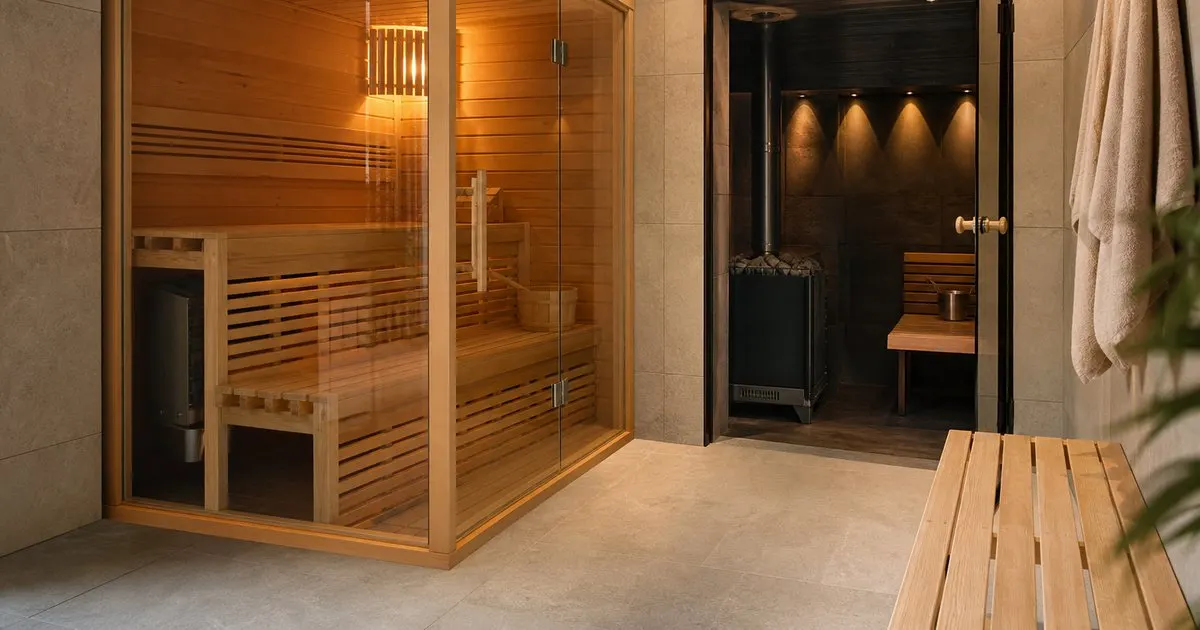
A traditional electric heater for a home cabin is commonly sized in the range of 4.5 to 9 kilowatts depending on room volume, and it needs 30 to 60 minutes to bring the rocks and the air to temperature before anyone steps in. That warm-up is pure consumption, and the heater continues to cycle heavily through the session because the air is being held at a much higher temperature than an infrared interior. Related: How do infrared and traditional cabin saunas actually differ for a home installation?
The practical result is that a traditional session often uses several times the energy of an infrared one. This is not a criticism, since many people prefer the experience and consider it worth every kilowatt hour, but it belongs in the buying decision. Wood fired outdoor saunas shift the cost from the electricity bill to firewood and time, and the accounting is different rather than lower.
Costs beyond the meter
Heater elements and infrared panels wear over years rather than months, but they are consumables and they will eventually need replacement. So will the lighting, the controller electronics, and the door gasket. Ask the seller for the price of a replacement heater panel before you buy, because a cabin built with proprietary parts that cost a great deal to replace is more expensive to own than its sticker suggests. Related: How do you tell a well built sauna cabin from a flimsy one?
One-time installation costs also deserve a line in the ledger. Many cabins above the smallest sizes need a dedicated circuit, and traditional heaters almost always do, which means an electrician's visit. Outdoor installations add a base or pad, and possibly trenching for the supply. None of these are monthly, but spreading them across the years you expect to own the cabin gives a more honest picture.
Keeping the figure low without compromising the experience
Pre-heating only as long as necessary is the largest single saving. An infrared cabin rarely needs more than 10 to 20 minutes, and starting it from a phone or a timer so it is ready when you are avoids the habit of switching it on and forgetting it. Keeping vents partially open costs a little heat but improves comfort enough that most owners run shorter, better sessions.
Placement matters too. A cabin in a conditioned room reaches temperature faster and holds it with less cycling than one in an unheated garage or on a cold patio. If an outdoor installation is the goal, a well insulated model and a sheltered position pay for themselves in winter. Finally, using the cabin regularly is the best cost control of all, because the monthly figure divided across many sessions is trivial, while the same figure across two sessions is not.
- Running cost equals kilowatts times hours times your own utility rate, so use the number on your bill.
- Infrared cabins typically use far less energy per session than traditional heaters, largely because of warm-up time.
- Replacement heaters, electronics, and a dedicated circuit belong in the total cost of ownership.
- Shorter pre-heat times and a conditioned location keep consumption modest without shortening the session.

Julien Jimenez
Julien Jimenez is an independent software builder based in Paris. He designs, ships, and operates focused SaaS products for small businesses and independent professionals. Read the full author page.
The Home Sauna, Chosen Well
The considered guide to infrared and cabin saunas for the home. Saunluxe is built to help you put this into practice.
Get the sauna guideMore from the Saunluxe blog
Get the complete home saunas guide
Our full buying guide, the price guide, and new research as we publish it. One email, no spam, unsubscribe any time.