When should you replace the heaters in an aging infrared home sauna?
Infrared panels fade rather than fail, which makes the moment to act hard to spot. The symptoms, the tests, and when a new cabin is the wiser spend.
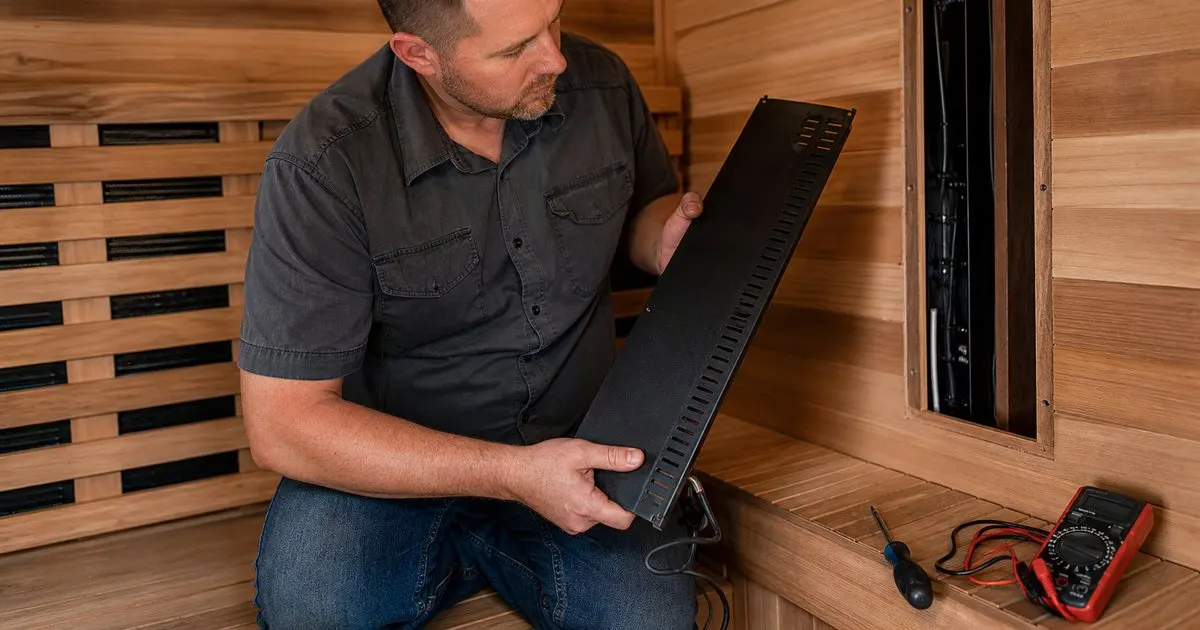
How infrared heaters age
Carbon fiber panels and ceramic emitters do not usually stop working abruptly. Their output declines gradually as the heating element degrades, so a cabin that took 15 minutes to warm in its first year may take noticeably longer years later, and the owner, who has adjusted session by session, rarely notices. Ceramic rods are more prone to outright failure, often after being knocked or after a power surge, while carbon panels tend to develop sections that go cold while the rest continues to warm.
Manufacturers publish a rated life in hours for their heaters, and the honest way to compare your cabin against that figure is to estimate your total hours of use. A cabin used four times a week for 40 minutes accumulates well over a hundred hours a year, and over a decade that adds up. The rating is a guide rather than an expiry date, and how the cabin has been treated, particularly with regard to ventilation and voltage stability, matters as much as the hours.
Keep reading: How do infrared and traditional cabin saunas actually differ for a home installation?, What should you look for in the wood used to build a home sauna?, Which room in a house is best suited to installing a private sauna?. See how Saunluxe helps you the considered guide to infrared and cabin saunas for the home.
Symptoms worth investigating
The clearest signs are uneven warmth across a panel, a panel that is noticeably cooler than its neighbors after full warm-up, discoloration or bubbling on a heater surface, and a warm-up time that has crept upward. A controller that throws errors, or lights that dim when the heaters cycle, points to electronics or supply problems rather than the heaters themselves, and replacing panels will not fix it. Related: Are far infrared and full spectrum heaters worth the premium in a sauna?
Before ordering anything, test methodically. Run the cabin to temperature with the door closed and hold a hand near each panel at the same distance. An inexpensive infrared thermometer pointed at each panel surface gives you numbers to compare. If one panel reads far below the others, the problem is that panel or its connection. If all panels are weaker than they should be, look at the supply voltage, the controller, and the wiring before blaming the heaters. Related: How do infrared and traditional cabin saunas actually differ for a home installation?
Replacing a heater sensibly
Match the replacement to the original in type, wattage, and physical dimensions, and buy from the cabin's manufacturer if parts are still available, because heater panels are wired into a system that expects a particular load. Mixing a higher wattage panel into a set can overload the controller or the circuit. Turn off power at the breaker, photograph the wiring before disconnecting anything, and have an electrician handle the work if the connection is anything more than a plug.
This is also the moment to consider whether an upgrade makes sense. Some manufacturers offer full spectrum panels as replacements for far infrared originals in the same cabin, which can be a worthwhile refresh if the controller supports it. Confirm compatibility in writing before buying, and be realistic: an upgrade that requires a new controller and rewiring is a substantial project, not a swap. Related: What is the best way to evaluate a sauna warranty before spending five figures?
When a new cabin is the better decision
If the cabin is a decade or more old, several panels are weak, replacement parts are discontinued, and the controller is showing its age, the total cost of piecemeal repair can approach a meaningful fraction of a new cabin that will be more efficient, better shielded, and under a fresh warranty. Wood condition matters too. A cabin whose panels have darkened, warped at the joints, or absorbed years of odor is not fully renewed by new heaters.
Conversely, a well built cabin with sound wood and a modern controller deserves new heaters and another decade of use. Where this guide links to replacement parts or cabins we may earn a commission, which is why we suggest getting a quote for parts and a quote for a comparable new cabin, then deciding on the numbers rather than on sentiment about either. Related: How do you tell a well built sauna cabin from a flimsy one?
- Infrared heaters fade gradually; a creeping warm-up time is the most common sign owners miss.
- Test each panel at temperature with an infrared thermometer before blaming the heaters for a controller or supply fault.
- Replace like with like in type, wattage, and size, and confirm any full spectrum upgrade is compatible in writing.
- When several panels are weak, parts are scarce, and the wood is tired, price a new cabin against the repairs.

Julien Jimenez
Julien Jimenez is an independent software builder based in Paris. He designs, ships, and operates focused SaaS products for small businesses and independent professionals. Read the full author page.
The Home Sauna, Chosen Well
The considered guide to infrared and cabin saunas for the home. Saunluxe is built to help you put this into practice.
Get the sauna guideMore from the Saunluxe blog
Get the complete home saunas guide
Our full buying guide, the price guide, and new research as we publish it. One email, no spam, unsubscribe any time.